A quick look at job listings shows the boundaries between creative disciplines blurring. Designers are expected to understand technology, and marketers now produce content that once took an entire creative team. People without a design background can make things that needed specialist skills a few years ago: an economist builds their own website, a developer writes copy, a designer writes code.
It's an exciting time to work in a creative field, although exciting might be putting it mildly. Maybe this is a creative renaissance. Or maybe we're just trying to keep up with the tools and trends that arrive every other Tuesday.
We don't have Madame Web's powers, so we can't say exactly what the creative professions will look like in five or ten years. Research already shows how fast things are moving, though. In AI in Design 2026, a survey of more than 900 designers in 60 countries, weekly AI use for design tasks rose from 54% to 91% in a single year. The report also describes designers going beyond traditional deliverables to build tools, develop systems and take a more direct part in product and business decisions.
When technology makes it easier to create, making the right creative choices matters more. For us, that comes down to the eye, the head and the heart.
The eye: taste is a skill
When more people can produce, the ability to choose matters even more.
AI can generate images, explore visual directions and produce endless variations in seconds. Knowing whether any of it works is a different job.
Taste is more than personal preference. It develops over years of making things, experimenting, getting it wrong, studying visual language and doing a lot of looking. A well-trained eye, experience and sound aesthetic judgement may be among the most useful skills a creative leader brings to the table.
The head: direction matters
More possibilities don't necessarily lead to better solutions.
When we can generate and produce faster and faster, it's tempting to jump straight to an answer. But are we solving the right problem? Good creative work starts with understanding the business, the audience and the actual challenge. A clear strategy gives direction to how the work looks, sounds and feels.
As AI speeds up more of the production process, strategic thinking becomes even more important. In a 2026 Superside report, six in ten creative leaders expected it to grow in importance as AI develops.
A good creative leader knows when to zoom out to see the whole picture and when to zoom in on the details that make an idea work.
Strategic creative leadership connects business goals, human needs and creative possibilities. It means challenging assumptions and sometimes questioning the brief instead of just delivering against it. Occasionally the most useful thing a creative can do is point out that we're asking the wrong question.
A good creative leader knows when to zoom out to see the whole picture and when to zoom in on the details that make an idea work.
The heart: why something just feels right
Technology can help us create, but making people care takes human understanding.
The strongest creative ideas come from observations, conversations, culture, places and people. They come from noticing small things in how people behave: what catches their attention, what matters to them and how they connect with others.
Some of this knowledge is hard to put into words. It's an instinct for what will land with people, built through experience, curiosity and paying attention to the world. Human-centred design puts that understanding to work through observation, empathy and testing, so we can move beyond what people say they want and understand how they actually experience things. Those insights shape stories, interactions and visuals that feel relevant and intuitive, and that move people.
Speaking of the human touch: as AI makes visuals easier to produce, we're seeing interest in work that feels more tactile, individual and "less perfect". Trend forecasts for 2027 point to hand-drawn elements, expressive typography, layered collage and visible textures – work that shows more of the person and process behind it.
Imperfection isn't automatically more authentic than polish, of course, and a trend isn't an idea. The job is to understand why an expression resonates and whether it fits the brand, its audience and the story it wants to tell.
A visual solution can be technically impressive and still miss the point. The challenge is making something people genuinely connect with.
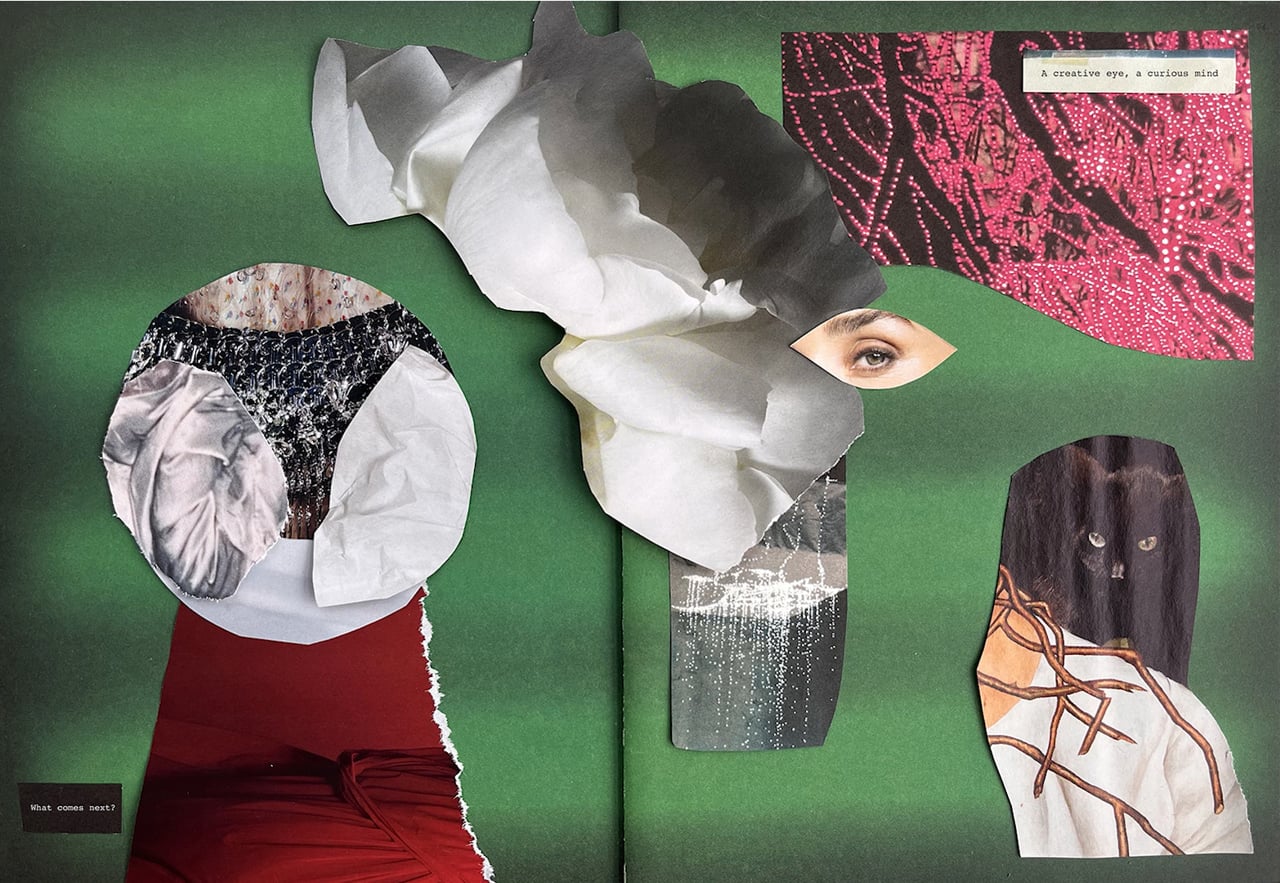
Collage: A creative eye, a curious mind and a human touch, all in a good old-fashioned collage. We may not have a crystal ball 🔮 to predict the future, but we believe the best creative work comes from looking beyond the obvious, asking the right questions and understanding what makes people connect.
A few things worth slowing down for
Good ideas need room to develop
Research on creativity suggests that our first ideas often draw on familiar references and obvious solutions. But what comes easily is not necessarily what is most original. Research on the Creative Cliff Illusion suggests that we underestimate our ability to keep generating creative ideas. We expect our ideas to become less original as we continue, even though they often remain just as creative or become more original.
When everyone is focused on speed, it's easy to see the process as something standing between the brief and the result. In practice, the process is how we find out what the result should be.
Getting past the obvious takes curiosity, experimentation and a willingness to question our own assumptions. More ideas don't automatically mean better ones, but giving them time to develop leaves room for connections and solutions we'd otherwise miss. When everyone is focused on speed, it's easy to see the process as something standing between the brief and the result. In practice, the process is how we find out what the result should be. And it's also often the most enjoyable part 😉
Small teams can do more
Creative work may come to depend less on big teams and more on combining the right skills and tools and knowing where expertise makes the biggest difference.
At WeForm, that means combining a small, experienced team with a broad understanding of strategy, design, technology and communication, and bringing in specialist partners when a project calls for it. What counts is knowing what to do, why it matters and who is best placed to do it.
For our clients, that means working directly with the people who help define the problem, challenge assumptions and turn a clear strategy into distinctive work. Not just a team to deliver the finished result, but a partner in figuring out what it should be.
New tools, experienced hands
Some tasks will change, some skills will matter less, and new opportunities will appear. At WeForm, we bring more than 20 years of experience in visual communication and branding to whatever comes next.
We see AI as another tool in our toolkit. It gives us a sparring partner for ideas, helps us explore visual directions faster and opens up new ways to build digital platforms.
Our role is to ask the questions, define the challenges and decide which ideas are worth taking further. From the first conversation to the finished work, we bring a trained eye, clear thinking and an understanding of people to the choices that matter.
New tools give us more room to explore. Our experience helps us decide where to go.